
Hampden County Traffic Warrants Explained
Think of a Hampden County traffic warrant as a court order, not a line on a driving record. The path there is standard: a citation gets filed in a District Court, the driver blows past the payment deadline or skips the hearing, and the court enters a default. Once that happens, you are dealing with a real case. It has a docket, a clerk, and a courtroom. The two flavors differ, though. An ordinance or civil motor vehicle matter can default just from an unpaid bill. A criminal traffic charge can bring an actual warrant and a far heavier set of consequences. The clerk will tell you which one is sitting on your name.
Hampden Traffic Warrants Are Court Process
Massachusetts keeps traffic cases inside the regular court system. The District Court Department hears city and town ordinance violations along with traffic matters. Whatever division took the citation owns any warrant that follows. So the useful question has nothing to do with points or insurance. In Hampden County you need to know which division filed the ticket, what the docket says, and whether a magistrate or judge must act before the default comes off.
Note: Court staff answer questions about the case, but they cannot discuss driving history, insurance, or anything that is not in the file.
Checking for a Traffic Warrant
The citation number is your fastest way in. The public case index takes a ticket or citation number in its own tab. An exact case number works too, once the matter has been docketed in a Hampden County court.
- Find the court on the citation or the hearing notice, and copy the citation number exactly.
- Search the Trial Court case access portal using the ticket or citation tab.
- Read the event list for a default, a warrant event, or a later removal.
- Call the division clerk and ask whether the default is still active and what removes it.
- If the matter is not in the division you expected, try the division that serves the town where the citation was written.
Note: A citation can be filed outside your home division, because the filing follows where the ticket was written.
Which Hampden Court Holds the Warrant
Five divisions cover Hampden County. Each one publishes its own traffic geography, so use the town where the ticket was issued, not the town on your license.
| Division | Traffic Geography | Clerk Phone |
|---|---|---|
| Springfield District | Springfield, Longmeadow, and West Springfield | 413-748-8600 |
| Chicopee District | Chicopee | 413-598-0099 |
| Holyoke District | Holyoke | 413-538-9710 |
| Palmer District | Brimfield, East Longmeadow, Hampden, Holland, Ludlow, Monson, Palmer, Wales, and Wilbraham | 413-283-8916 |
| Westfield District | Agawam, Blandford, Chester, Granville, Montgomery, Russell, Southwick, Tolland, and Westfield | 413-568-8946 |
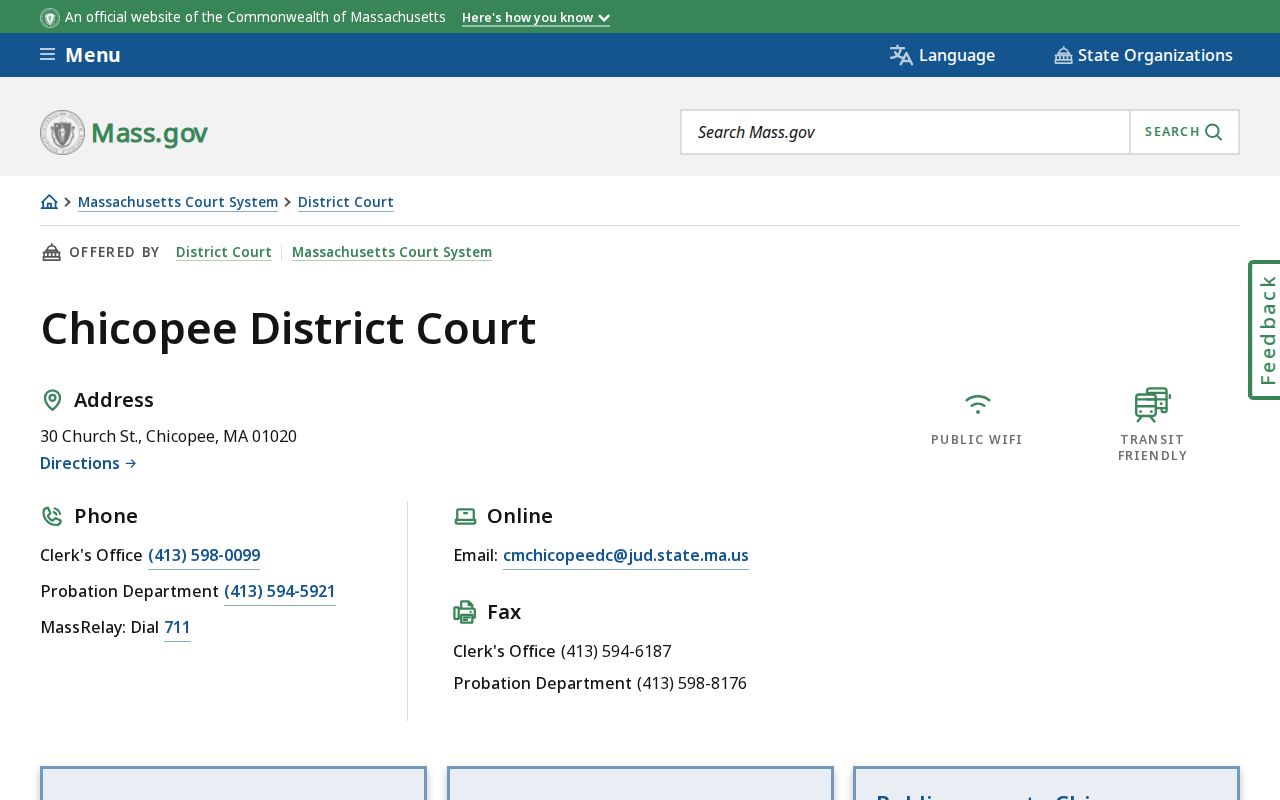
The Chicopee District Court page looks like the other published courthouse pages in Hampden County. It lists parking, transit, and the clerk contact for that division.
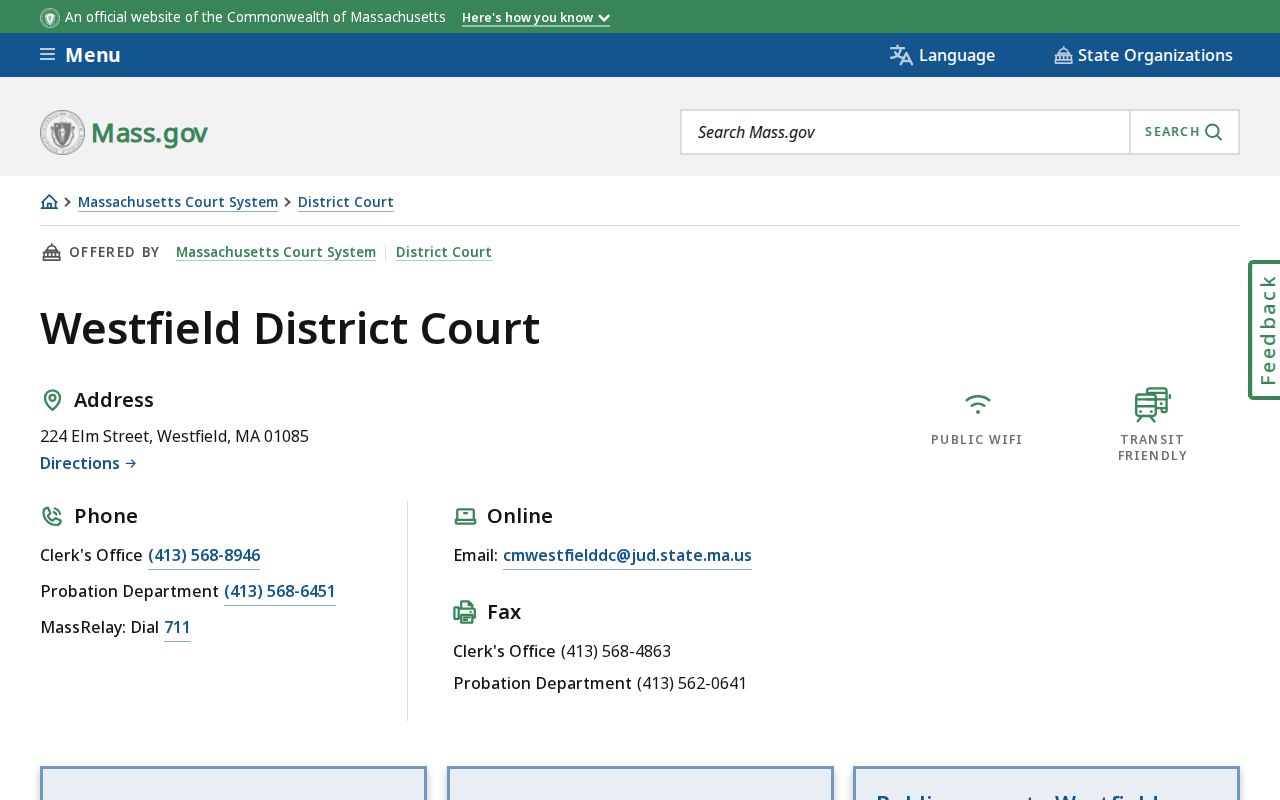
The Westfield District Court page covers the western division of Hampden County. It serves nine towns, including Agawam, and lists municipal lots plus two transit routes.
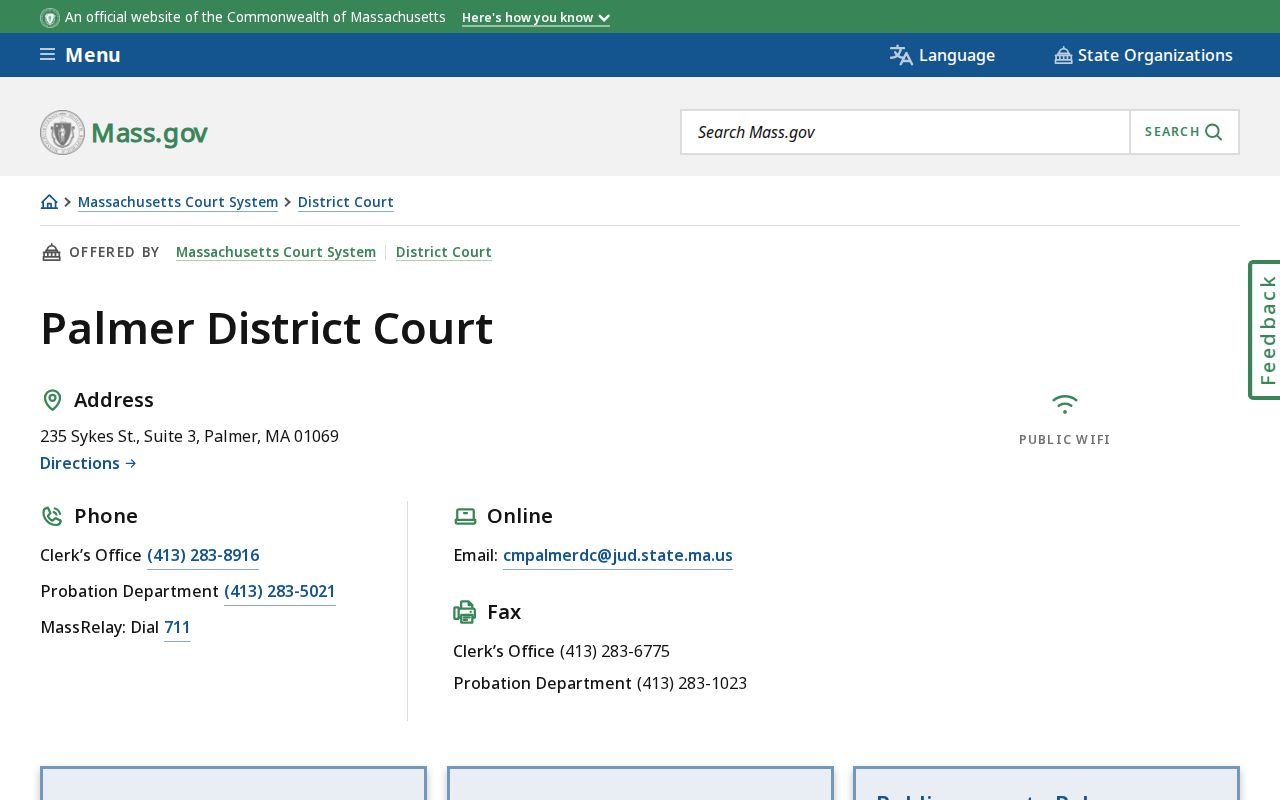
The Palmer District Court page covers Hampden County's eastern division and notes free parking with no public transit.
Inside a Traffic Warrant Record
A Hampden County traffic warrant record is really a docket. A few fields on it decide what happens next.
| Citation Number | Printed on the ticket as 2026-TR-001234 and used for the citation search tab. |
|---|---|
| Case Number | Assigned once the matter is docketed, and required for a payment or a motion. |
| Court Division | The courthouse that holds the file and controls the default. |
| Charge or Violation | The civil motor vehicle or criminal traffic charge at issue. |
| Event History | Hearing dates, the default, and any later removal or disposition. |
| Amount Owed | Stated on a payment-only default, with the assessment separated out. |
Under Massachusetts law, a payment-only default must state the amount and the added assessment. That is why the notice and the Hampden County docket should agree.
Removing a Hampden Traffic Warrant Default
Missed hearing? The state's traffic guidance gives one route. Ask the magistrate or judge to remove the default and reschedule. The Hampden County court decides whether your reason is good enough.
- Call the division clerk and confirm that the docket shows a default rather than an unpaid balance.
- Ask where and how to file a motion to remove the default, and whether a fee applies.
- File the motion with the reason for the missed date, and keep the stamped copy.
- Attend the new date, and ask for written proof when the default comes off the record.
The traffic ticket hearing guide walks through a hearing in Hampden County, including what a clerk or magistrate will ask.
How to Pay or Lift a Traffic Warrant
Some Hampden County defaults clear with money. Some do not, and mixing the two is the most common mistake here.
Caution: An electronic payment does not remove an outstanding warrant. The court still has to record the discharge on the case.
Where payment is allowed, Quick Pay handles eligible fees if you have the complete case or docket number, and it adds a 3.5 percent convenience fee. Where the court requires a motion, money alone will not clear the default, and a warrant lookup will keep showing the case as open. Ask the clerk three things: whether payment alone discharges the default, what the total comes to, and when the record updates after you pay. Hampden County courts answer these questions every day.
Hampden Court Warrants and Tax Flags
A second kind of notice in Hampden County carries the word warrant without being a court case at all. Westfield's online payment page explains that a municipal motor vehicle excise bill which has produced a warrant or a registry flag must go through the deputy collector for timely removal. That is a tax and registration collection process. It is not a criminal court default, it does not get resolved at a clerk's counter, and it never appears in a court docket. Both problems can be live at once. Before choosing a route, read which office issued the notice.
Note: A tax warrant is paid to a collector, while a court default is cleared by a court.
Hampden County Warrant License Holds
Let a criminal traffic matter sit in Hampden County and the fallout can reach past the courtroom. The state warns of license suspension, fees, and a warrant when a criminal traffic charge goes unaddressed. Separately, chapter 276, section 23B sets up its own process for suspending professional licenses, certificates, and permits after qualifying defaults. That process builds in notice and hearing rights, so it is not an automatic permanent loss. Treat a licensing notice as a deadline and respond through the Hampden County court that issued the default. None of this is a driving-record product. The question is always the court case and its status.
Traffic Warrants, FTA, and License Holds
Three related ideas get used interchangeably, and they lead to different offices.
| Item | What It Is | Where It Is Handled |
|---|---|---|
| Traffic default warrant | A court order after a missed date or unpaid order | The District Court division holding the case |
| Failure to appear | The event that triggers the default | The same court, recorded on the docket |
| License or professional consequence | A separate statutory result of a qualifying default | The licensing process, with notice and hearing rights |
| Excise or registry flag | A tax collection matter | The municipal deputy collector |
Key Rules: Ask the clerk which category applies before paying anyone, and remember that the municipal warrant page covers ordinance cases that also route through the District Court.