
Checking for a Warrant in Springfield
Springfield publishes no public warrant list. What exists is a court record, and the clerk who opened the case is the one who holds it.
- Identify the department that issued it. Felony matters sit with the Superior clerk; local criminal, traffic, and ordinance cases sit with the District Court division.
- Gather what a clerk will ask for: full legal name, date of birth, and the case or citation number.
- Search the Trial Court case access site with the exact case number, then read the result as orientation, not live status.
- Call the District Court clerk at 413-748-8600, or the Superior criminal business office at 413-735-6017, and ask whether a default is open.
- Ask what the court needs next, and request written proof when the file closes.
Note: City police can explain a surrender or bail question, and they cannot change the docket.
Where Springfield Warrant Checks Begin
Most Springfield warrant checks start at a single address. Superior Court, the District Court division, the Court Service Center, and the Hampden Law Library all share the courthouse complex at 50 State Street, while police headquarters sits a few blocks away on Pearl Street. Sharing a building is not sharing a file, though. A felony matter and a District Court case can both come from that address yet sit with different clerks and different sessions, so find out which department owns the matter before anything else.
Springfield Police and the District Court
The Springfield Police Department makes arrests and serves process in the city, but it will not confirm warrant status by phone or online. The nonemergency lines are 413-787-6300 and 413-787-6302. The Records Bureau is 413-787-6363. Springfield District Court hears the city's criminal, traffic, and ordinance matters, and it also serves Longmeadow and West Springfield; that clerk can say whether a default is open and what the court needs to close it. The Springfield police contact page lists the department's nonemergency, records, and text tip channels.
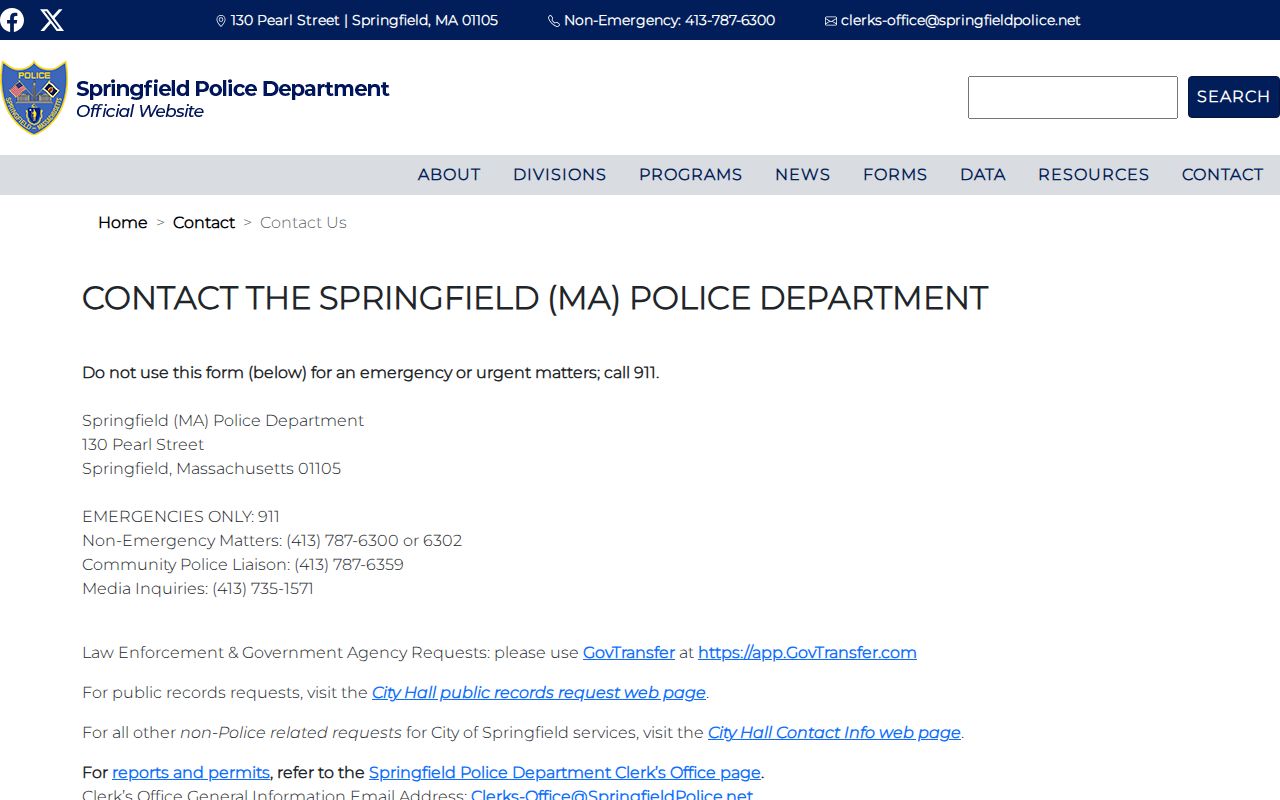
None of those Springfield channels is a warrant search, so the clerk stays the confirmation route.
Springfield District Court
50 State Street, Springfield
413-748-8600
Hampden County Superior Court
Clerk of Court, criminal business
413-735-6016
The Springfield Warrant Apprehension Unit
The Firearms Investigation Unit includes a Warrant Apprehension Unit, whose published description says it locates and arrests people wanted on outstanding felony warrants. It works with the Marshals task force, the State Police fugitive section, and the sheriff's office. That is enforcement, not records. The unit posts no search box and no roster, and Springfield offers no city warrant portal behind it.
Note: The unit's page explains how arrests are coordinated, and it does not confirm a warrant for a named person.
Springfield Warrant Types
Massachusetts labels its court process precisely, and a Springfield docket label helps when you call.
| Warrant Type | How It Arises | Who Issues It |
|---|---|---|
| Arrest warrant | A complaint supported by probable cause | A District Court justice, or a Superior judge after indictment |
| Default warrant | A missed court date or a failure to obey an order | The court where the case is pending |
| Bench warrant | Nonappearance or contempt | The judge or magistrate handling the case |
| Search warrant | Probable cause to search a place or person | A judge or magistrate, with restricted papers before the return |
| Civil capias process | Civil, probate, or child support service | The sheriff's process division |
The label decides the next step, because each version takes a different route.
Springfield Arrest Logs and Warrant Labels
The Springfield police arrest log page posts weekly PDFs, and those files come closest to a public listing. Each entry carries an arrest number, report date, arrest time, location, offense coding, court code, and crime class, and some reference a default warrant. Read the log as a publication, not a status check. It covers arrests from one week, so a Springfield name that never appears can still carry an open default.
Inside a Springfield Warrant Record
What the clerk reads back comes from the Springfield docket and the state warrant entry, not a downloadable file.
| Case or Docket Number | The court's number, recorded as 2026-CR-001234 on the complaint. |
|---|---|
| Party Name | The person named on the complaint, spelled as the court spells it. |
| Charge or Case Type | The offense or case kind, such as a charge, a citation, or an ordinance violation. |
| Issuing Court | The department and division that opened the case, the only office that can clear it. |
| Event History | Arraignment dates, the default, and any later recall or removal entry. |
| Amount Owed | Stated on a payment-only default along with the added assessment. |
| Status | Active, recalled, or served, as the clerk states it on the day you call. |
Start with the case number and the issuing court. Every later question about a Springfield warrant depends on which clerk owns that file.
Springfield Default Warrant Recall Questions
When a Springfield default turns up, the sequence is a phone call and then a court step. Ask the clerk whether it stems from an unpaid amount, a missed hearing, or a criminal appearance, because that answer shapes what comes next. A payment-only default can sometimes be handled through the state's online payment channel using the full case number, an email address, and a 3.5 percent convenience fee. Payment alone does not remove the warrant, though.
Caution: Paying a Springfield court fee online does not clear an outstanding warrant, so ask the clerk for proof of the recall before treating the matter as closed.
Removing a Springfield default warrant generally carries a $50 fee under state law, which a court can waive for hardship.
How Springfield Warrants Fit the County System
A Springfield case is one slice of a county system with several clerks and one state database. The sheriff serves civil process rather than criminal warrants. The state warrant system is a law enforcement tool, not a public website. So the issuing court stays the office that can confirm and clear a Springfield entry.
Warrant flow: Springfield District Court and Superior Court › Hampden County Sheriff's Office › Trial Court Warrant Management System
A Springfield warrant is only part of the picture. The other four District Court divisions sit in Hampden County warrant records.
Springfield Traffic and Ordinance Warrants
An ignored Springfield ticket becomes a court default, not a police matter. Ordinance violations follow the same path. A citation number is worth as much as a name when you call.
| Point | Traffic or Ordinance Default | Criminal Warrant |
|---|---|---|
| Origin | A citation missed or unpaid | A charge filed after probable cause |
| Issued by | The District Court handling the citation | A judge or clerk-magistrate |
| First step | Call the clerk about a motion to remove the default | Call counsel and the clerk about a surrender or bail |
| Record location | The District Court docket | The docket plus the state warrant entry |
A magistrate or judge decides whether a missed Springfield hearing is excused. The county page on traffic warrant searches repeats this route for the other divisions.
Springfield Warrant Records and Public Access
Massachusetts public records law reaches documents a city or sheriff's office holds, but it does not turn a warrant into a public listing. A Springfield clerk can hand over a copy of a public docket, while some material stays out of reach. Juvenile files, sealed records, and the papers behind a search warrant before the return each carry their own limit. A records request gets you a document; it does not clear a Springfield warrant.
Key Rules:
Massachusetts Public Records Law, G.L. c.66, section 10 - a written request should draw an initial response within ten business days.
G.L. c.276, section 23A - creates the Trial Court warrant management system and limits who may read it.
G.L. c.119, section 60A - keeps juvenile court records confidential except in narrow cases.
Springfield Court Service Center Limits
The Court Service Center at the Springfield courthouse is a free self-help office where staff explain forms and describe how a hearing works. The Hampden Law Library nearby offers research access. Neither office gives legal advice or promises a same-day recall. Use both to get ready, then call the clerk who owns the Springfield docket.