
Hampden County Bench Warrants Explained
A bench warrant adds no new charge in Hampden County. It is pressure, plain and simple: a judge's order compelling an appearance or a payment the court already required. Once the judge signs it after a missed obligation, the case stalls behind that order until someone clears it. Three triggers cover most of them. Missing an arraignment or a hearing is the first. The second is ignoring a court order, and the third is an unpaid amount tied to a case. A fourth path runs through probation, where the probation office attached to the file can seek a surrender or violation warrant of its own.
Note: A bench warrant follows the case, so resolving it puts you back on the docket rather than closing the matter.
Default Warrant: Hampden's Own Term
Clerks in Massachusetts rarely say bench warrant. The docket term is default warrant, meaning process issued after a failure to appear or a failure to comply. Ask a Hampden County clerk about a bench warrant and you may get a polite correction instead of an answer. Lead with the case number and ask about the default.
- Default warrant
- The Massachusetts term for process that follows a missed appearance or an unpaid court obligation.
- Bench warrant
- A common description of the same judge-issued process. Ask the clerk for the docket's exact wording.
- Capias
- A writ the sheriff's process division serves in civil, probate, and family matters.
- Recall
- The court action that withdraws the warrant once the obligation is satisfied.
- Payment-only default
- A default warrant issued solely for an unpaid amount, which must state what is owed.
One word, one record. Using the court's own vocabulary shortens the call considerably.
How Hampden County Bench Warrants Are Issued
Skip a summonsed court date without reasonable cause in Hampden County and the court can hold you in contempt and issue a warrant. Chapter 276, section 26 supplies that contempt route, and a judge or magistrate weighs whether the excuse offered is good enough. The clerk then enters the warrant into the state system. Under chapter 276, section 23A, the notice must name the issuing court, the charge, the way to clear the warrant, and the consequence of leaving it uncleared. One more wrinkle matters here. A prosecutor can request cancellation of a warrant never executed, so a Hampden County warrant that once issued does not always stay live.
Note: Notice timing does not pause the warrant, and the order takes effect when the court issues it.
The Missed-Date Timeline in Hampden
The sequence runs short and predictable. That helps when you are piecing together what happened to a Hampden County case you lost track of.
Court date passes › Court finds no reasonable cause › Default warrant issues and is entered in the system › Clerk sends notice › Warrant is served, surrendered on, or recalled › Case resumes on the docket.
Most people who run into trouble sit somewhere in the middle of that line, not at the end of it. The Hampden County clerk can tell you exactly which step your case reached and whether the warrant is still active in the system. An old notice does not mean an old warrant. Records stay open for years, and a case from a previous decade can still carry active process.
Bench Warrants and Arrest Warrants Compared
Both authorize custody. They just arrive from opposite directions in Hampden County. An arrest warrant starts with probable cause for an offense, while a default warrant starts with an obligation the person failed to meet.
| Point | Default or Bench Warrant | Arrest Warrant |
|---|---|---|
| Trigger | A missed appearance, missed payment, or violated order | Probable cause on a complaint or indictment |
| Issued by | The judge handling the existing case | A judge or clerk-magistrate on a new charge |
| Typical fix | Payment, a motion to remove the default, or an appearance | Surrender, bail, or counsel arranging an appearance |
| Effect on the case | Pauses and restores an open case | Begins a case that was not yet in court |
What you ask for differs, and that is the practical split. A default usually needs a removal or a recall; an arrest warrant needs an appearance and a bail decision.
Hampden Warrant Clerks by Court
One county, five District Court clerks, plus the Superior, Juvenile, and Probate and Family offices. Match the courthouse named on your notice to the numbers below. Call that Hampden County office, not the one nearest your house.
| Court | Phone | Default Warrants It Handles |
|---|---|---|
| Springfield District | 413-748-8600 | Springfield, Longmeadow, and West Springfield criminal, traffic, and ordinance defaults |
| Chicopee District | 413-598-0099 | Chicopee criminal, traffic, and ordinance defaults |
| Holyoke District | 413-538-9710 | Holyoke criminal, traffic, and ordinance defaults |
| Palmer District | 413-283-8916 | Eastern Hampden defaults, including Ludlow, Monson, and Wilbraham |
| Westfield District | 413-568-8946 | Western Hampden defaults, including Agawam and Westfield |
| Hampden Superior | 413-735-6016 | Felony dockets, with criminal business at 413-735-6017 |
The Hampden courthouse list shows every department and its address. Use it to confirm which Hampden County building serves your case.
Hampden County Payment-Only Warrants
Some defaults involve money and nothing else. Chapter 276, section 31 covers a default warrant issued solely for nonpayment, and the notice must state the amount plus the added assessment. Qualifying Hampden County cases can take payment by mail, phone, or electronic means.
| Amount Owed | Stated on the notice, with the additional assessment separated out. |
|---|---|
| Removal Fee | Generally $50 under chapter 276, section 30, waivable for hardship or good cause. |
| Payment Channels | Mail, telephone, or electronic payment where the court allows it. |
| What Payment Does Not Do | It does not by itself withdraw the warrant. The discharge still has to be recorded. |
Section 32 governs what happens when someone is brought in on a payment-only warrant. That is why a paid case in Hampden County can still end with a court appearance.
Resolving a Hampden County Bench Warrant
The state's own warrant guidance points to the issuing courthouse, the clerk, and the courtroom handling the case. Bring the notice, the case number, and proof of any payment. Add your lawyer's contact information if you have counsel in Hampden County.
Caution: Call before you travel. Recall procedures vary by division, and a clerk can tell you whether a judge has to see the case.
Ask four questions on that call. Is the default still active? Does the recall need a motion or a clerk setting, what documents belong with you, and how do you get written proof afterward? The Court Service Center at 50 State Street explains forms to a person without a lawyer.
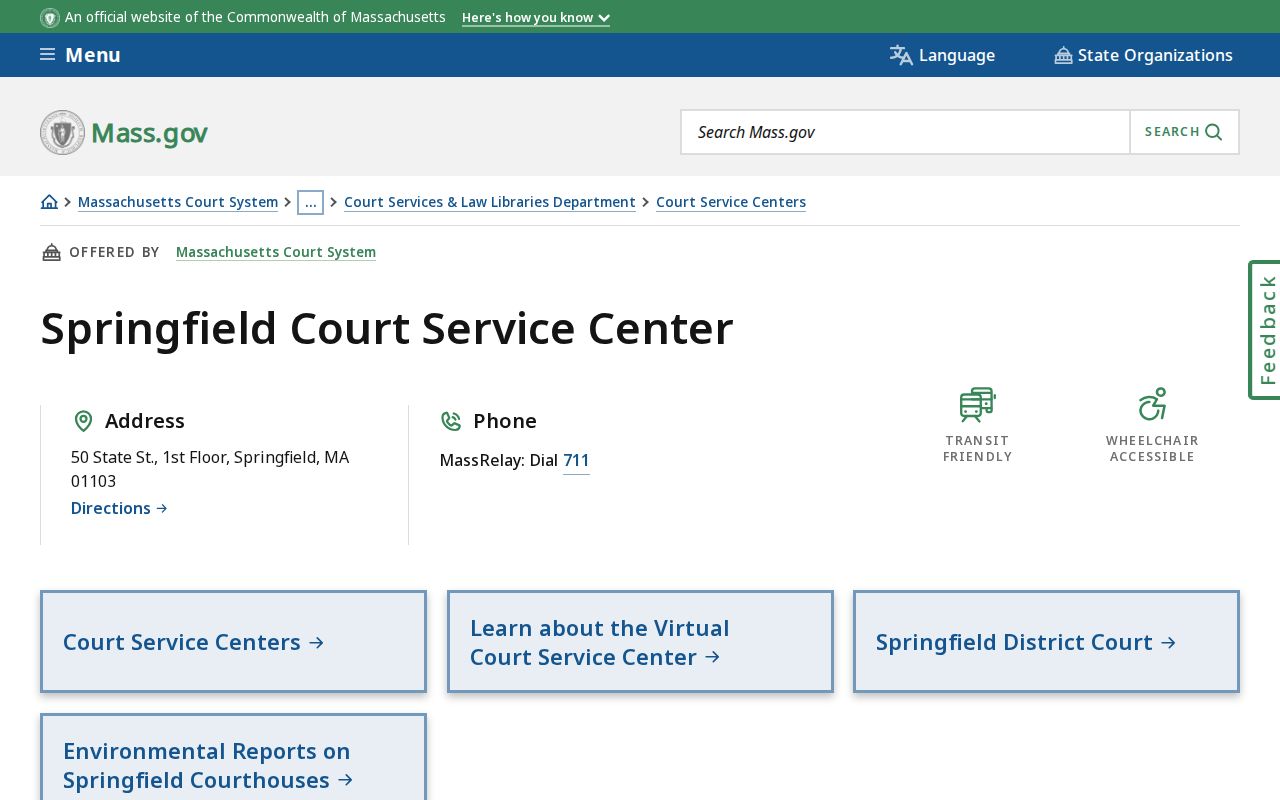
The service center page above lists its intake hours. It cannot give legal advice or disclose case status. The Hampden County warrant records overview carries the general steps for clearing a warrant, including how bail and surrender work when the case is already in custody.
Hampden County Juvenile and Family Warrants
Two Hampden County departments trip people up. Support and contempt process belongs to the Hampden Probate and Family Court. Its registry answers at 413-748-7760. The Chicopee satellite registry holds no hearings and takes no cash. Youth matters go to the Springfield Juvenile Court, where confidentiality rules limit what anyone outside the case can be told.
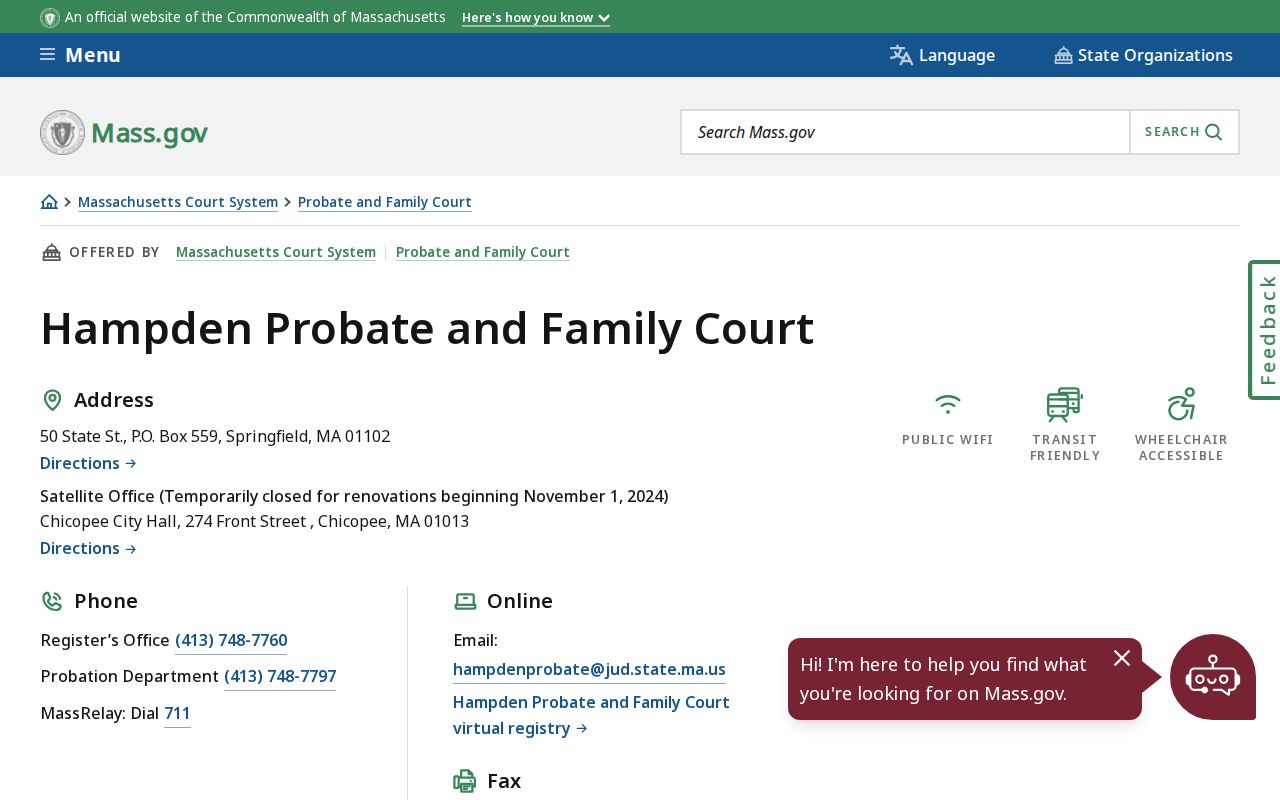
The Probate and Family page above is the source for registry hours and contact details. A family default is not resolved at a Hampden County District Court counter.
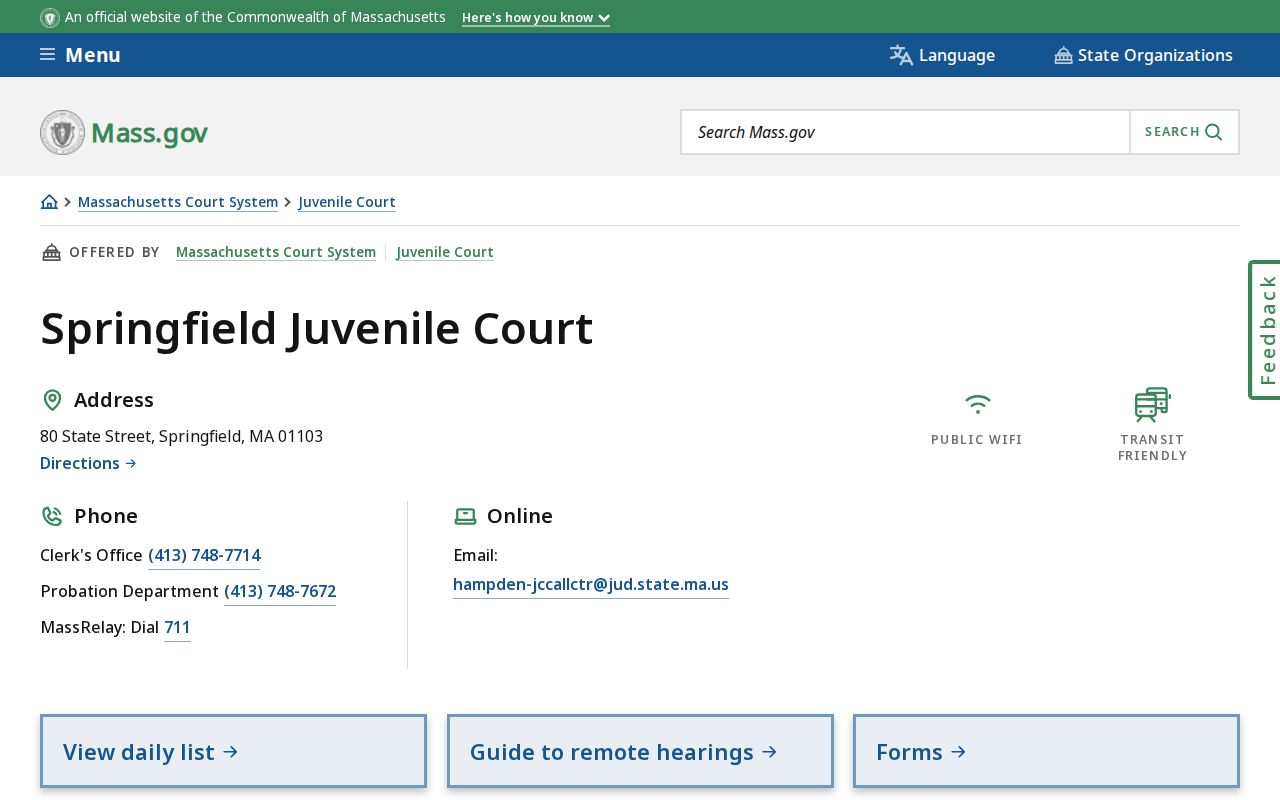
The Juvenile Court page above explains the session's service area. Its records stay confidential under Massachusetts law even when a warrant exists in Hampden County.
Finding the Court That Issued the Warrant
Work backward from whatever paperwork you still have. A citation names the court. A notice names the division. A support order names the registry, and a probation letter points to the probation office tied to the case. That trail usually answers the question before you call anyone in Hampden County. If nothing is left in hand, the state case index can find a docket by name or case number, and the warrant check guidance repeats the clerk route for a warrant lookup. One exception: a federal case never shows up in a Massachusetts docket at all.
Note: A default in a town you never lived in is possible, since the case follows where the matter was filed.